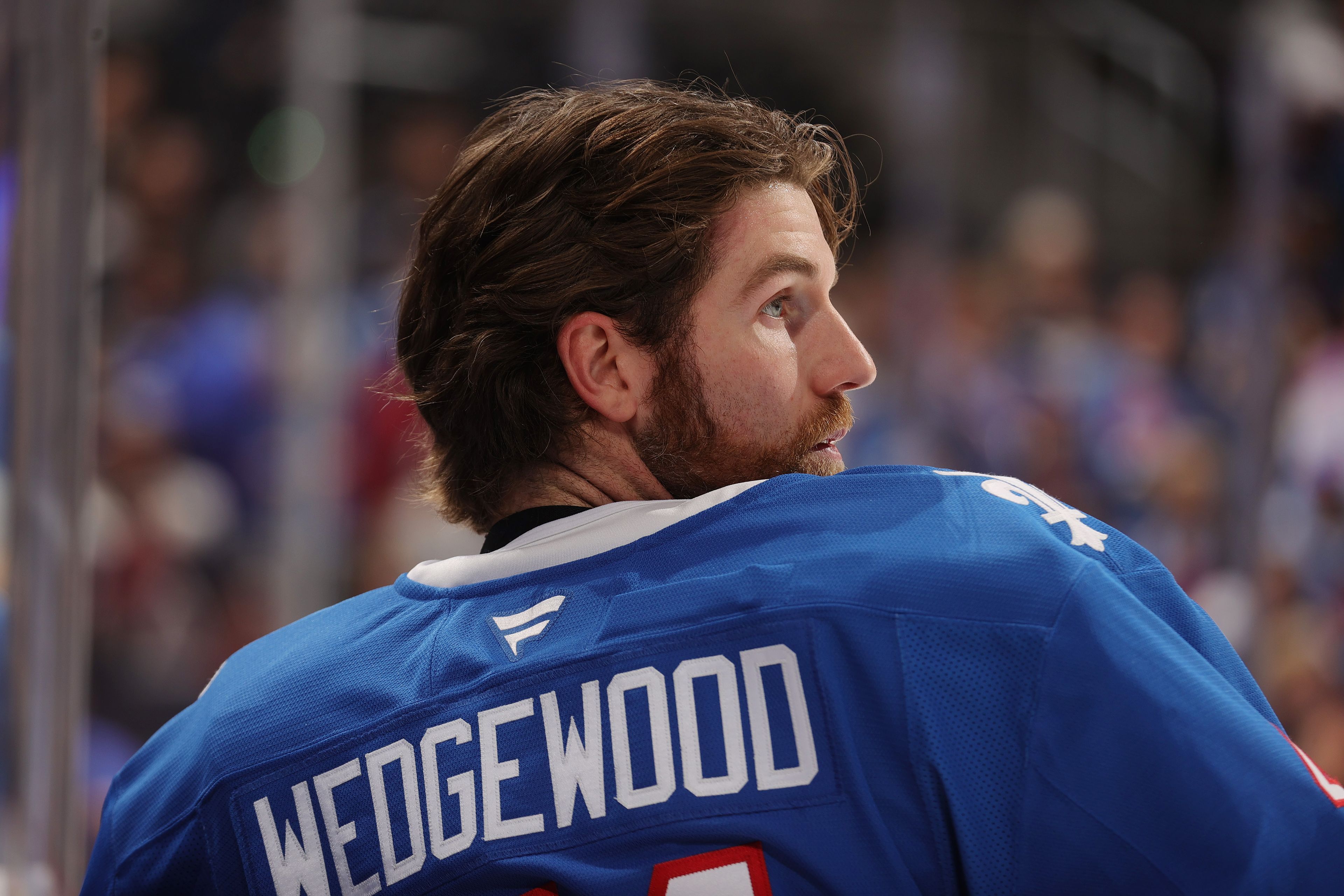


Scott Wedgewood has all the angles covered when it comes to perfecting his puck-stopping game plan.
The 2025-26 NHL season has been a memorable one so far for both Wedgewood and the Colorado Avalanche.
Thrust into the starting role after an injury to teammate Mackenzie Blackwood, 33-year-old Wedgewood has played an integral part in the Avalanche’s ascent to the apex of the Western Conference standings.
Wedgewood remains tied for second in wins with a 13-1-4 record, accompanied by a .919 save percentage.
What has Wedgewood, who signed a one-year contract with the Avalanche this November, learned about himself so far this season?
“First and foremost is that I am good enough to be a starter. I am proud of where I have been and how I got here. If you play well and do the right things, you will be given an opportunity.”
There have been plenty of twists and turns to where he now finds himself.
Acquired from the Nashville Predators last November in exchange for fellow goaltender Justus Annunen, Wedgwood has also suited up for Dallas, Arizona and New Jersey, who drafted him 84th overall in 2010. He was also a Black Ace when Tampa Bay hoisted the Stanley Cup in 2019-20.
The Ontario Hockey League graduate – he played parts of four seasons with Plymouth Whalers from 2008 to 2012 – has made numerous modifications to his game and mental approach over his NHL life.
“I look back and I came into the league with what you would call raw talent, a goaltender who would get in the way of pucks and do whatever I had to do – full splits, one-pad saves, the old-school VH on the post, standup, butterfly. I could do that all but I felt the inconsistency of what choice I made was causing rebounds or pucks to squeeze through me.”
Signing a two-year contract extension with Dallas in 2022 marked a major turning point in Wedgewood’s NHL career.
“When I got to Dallas and through all the ups and downs in Arizona and the trade – you get five different goalie coaches and different opportunities. So, with Dallas, it was that feeling of making it, where it was a ‘have to do something different’ mentality change. I was there and I did everything I needed to do to get that point, so I needed to then pivot my mindset to, ‘How do I make it last more?’”
The answer came in the form of a forensic deep dive into his playing style, a meticulous breakdown of every aspect of his game.
One of the major takeaways was how the 6-foot-2 netminder approached his mental game.
“I realized not every save has to be into the palm of your glove or off the middle of your blocker. You get hit, you take up space, and you find the right angle – that was the change of the mindset there.
“And then it moved into finding a way to hone that into the sense of me wanting to be reactive in net. I find if I am just waiting there to get hit – I am not as massive as some of the other goalies – they would find a hole or a bigger scoring opportunity. So, how do I frame up without holes and also be reactive at the right time?”
Wedgewood also simplified his thought process before each puck drop.
“It got to a point where your mindset completely changes. If you go out there thinking you need to get a shutout or make 40 saves your numbers will look great, which is what I had during my last tenure with New Jersey. I got traded to Arizona and played the last four games of the season and had a pretty good year going. I would think that I had four games to go and in my head I would think, ‘I need a shutout.’ And you go out there and you don’t play that well based on circumstances. Then my mind would turn to, ‘Don’t give up eight goals.’ And you wonder where that thought came from.”
Those thoughts were replaced by a simpler, more realistic perspective.
“If you go out and give up two goals on 25 shots in this day and age, my mind could understand that. Your mind can’t comprehend the approach of either getting a shutout or not giving up eight goals. But when you approach it in the middle – giving up two goals on 25 shots or three goals on 35 shots – that helps give the team the best chance to win.”
Mission accomplished.
His numbers across the board are a testament to the work he has put in on and off the ice.
“There are times this year when I have been scored on with the first shot, sixth shot and thirty-second shot. The other team is going to score goals. It is just the way it is. If you can calm your mind in that sense, it gives you less anxiety before games and puts you in the right mindset for what you need to do to be effective.
“You are better equipped to go out feeling that you are going to play well. If they score, that’s okay. If they score again, so be it.
“Even last year, I look back to games where a shot comes at me and I’m very aggressive. The puck hits me and I am two feet out of the blue paint, scrambling for a rebound on my stomach. You look at it, and it was a little chaotic. This year, those situations happen, but if I watch video, I can see that everything is framed and under control a lot more.”
Two years ago, Wedgewood hired a sports psychologist.
“It helped in the sense that you can offload stuff onto others. You talk to your dad, your wife, teammates, friends, all people who are in your corner. And then you pay someone and you feel as though they are in your corner, too.
“He has an outside viewpoint of, ‘You feel this way… why?’”
Wedgewood, who posted a 1.99 goals against average along with a .917 save percentage in 19 appearances last season with the Avalanche, has found clarity through uncovering the answers to those questions.
That said, he is still committed to strengthening his game.
“The elite basics and elite game plans I have made allowed me to understand I can be a top guy in this league. It is a long career process, and I don’t feel I’m anywhere near perfect. It’s a long learning curve, but it’s the most fun part of being a goalie – there is always something to learn and something to dissect.”
With the season set to ramp up, Wedgewood, who along with his wife, Brittany, will welcome a second daughter (their first, Scarlett, was born last March) at the end of January, is feeling more prepared than he has ever been to handle the pressures that come with it.
And if practice does indeed make perfect, Wedgewood, who faces some of the game’s elite talents – names like Nathan MacKinnon, Cale Makar, Martin Necas and Artturi Lehkonen – in morning skates, will be up for the challenge.
“What they do in practice keeps me on my toes. The amount of angle changes these guys can make keep you light on your feet. It’s a challenging thing every practice, but it’s also a huge plus to have that.”
Yet another opportunity for Wedgewood to pursue perfection between the pipes.