

From Detroit’s inner city to the remote community of LaRonge in Northern Saskatchewan to Pavol Demitra’s hometown in Slovakia to a superstar visit to Germany, the NHLPA Goals & Dreams program accomplishes the seemingly impossible – sprawling in scope and in its impact on young people, their families and their communities.
In so many ways that’s the beauty of the long-standing National Hockey League Players’ Association charitable program now entering its second quarter century.
The 2024-25 season marked 25 years of NHL players giving back to the game at the grassroots level for NHLPA Goals & Dreams. It was a year that saw impressive involvement from players who donated new hockey equipment valued at more than $900,000. That gear was distributed to 50 different organizations in 10 different countries. The recipients of the 1,050 sets of new hockey equipment ranged in ages from three to 21, and more than half of the organizations that requested a donation support youth from low-income or disadvantaged households.
That’s the sprawling part.
The smaller part, the part that speaks to the very heart of what NHLPA Goals & Dreams continues to strive to be? Well, you have to dig a little deeper for that.
Maybe ask veteran NHL player Tomas Tatar who recently was an integral part of G&D’s donation of 25 sets of gear in his hometown of Dubnica nad Váhom, Slovakia.
The kids who will receive this equipment attend the same elementary school Tatar attended when he was a youngster just learning the fundamentals of the game and dreaming of following in his older brothers’ footsteps as top players in the small hockey nation. His brothers, 13 and 16 years older than Tatar, played with Pavol Demitra for a time. Tatar recalled when Demitra, one of the biggest stars ever to come out of Slovakia, came to their school to talk about being a pro hockey player and the thrill of being so close to a real NHL player.
“Pavol was such a big person to the community in the hometown. He was one of the best players, one of the best Slovakian players in the NHL. Pavol was always such a kind guy and a well-respected player in the NHL,” Tatar said.
The school now bears Demitra’s name after the Slovak icon perished along with all the members of Lokomotiv Yaroslavl of the Kontinental Hockey League in September 2011 when the team jet crashed after takeoff.
“As I was growing up, he was one of my role models for sure,” added Tatar who was born 16 years after Demitra. It wasn’t just being an NHL player that made Demitra so important to Tatar and the entire country, but how he conducted himself and how Demitra never forgot where he came from.
“Probably the biggest impact was the person, what he had. And he was so friendly and nice to everyone,” Tatar said. “So, when Pavol came to the school, to visit the school, to say hi to the kids who played hockey, it was a big boost. I remember as a kid looking up, like that definitely gave me motivation to work hard and then follow the dream and do everything I possibly can to become or fulfill my dream to become an NHL player.”
To honour Demitra’s memory and to carry on the legacy of growing the sport in Slovakia through NHLPA Goals & Dreams is difficult to put into words for Tatar.
“As you know it's hard to get equipment, it's hard to get ice time. And to me, just to be in a locker room and to play the game and to have those experiences, man, it's, I don't know, there's nothing like it. So, to, you know, to open a door like that is, it's kind of magical,” said Tatar who will be playing in Switzerland this season and was one of the first players named to the Slovak team for the 2026 Milan-Cortina Winter Games.
It’s a long way geographically and in almost every other way from Slovakia to northern Saskatchewan, but the sentiments are no different as the folks in LaRonge await 25 new sets of equipment.
The NHLPA Goals & Dreams equipment donations in LaRonge have become a kind of rite of passage in the region that is home to the largest Indigenous community in the province, with 160 sets of equipment distributed since 2019.
As has been the case since the first skates and sticks arrived in the lobby of the local rink, Brent Nicol’s fingerprints are all over the moment. The long-time RCMP officer has been in LaRonge for 13 years. He’s also on the board of directors for the local junior hockey team, the Ice Wolves, who play in the Saskatchewan Junior Hockey League.
The Ice Wolves are coached by former NHLer Kevin Kaminski who learned about G&D from a police officer whose goalie was on a team he coached in Fresno, California.
Funny how it all works out, no?
When Kaminski took over as the Ice Wolves head coach he suggested to Nicol he might want to reach out to NHLPA Goals & Dreams, and Nicol set about preparing the paperwork to secure the new gear. It’s a process he has since repeated every year, with the latest shipment having arrived just before Nicol went on medical leave after his diagnosis with multiple myeloma, a form of cancer of the blood. He will soon be back on the job and looking forward to the next installment of hockey gear.
“It’s kids that don't have the chance to do it if we didn't give them equipment,” Nicol said.
“These kids start out pushing chairs trying to skate, and by the time they're done with them, in February, they're all out there skating and have got some of the fundamentals of hockey, and a lot of them are going on to play minor hockey in the La Ronge area. So, it's been a great program. It's had great support,” Nicol said.
All these things are connected. It’s not just drop off the gear and see you later. The community has to do its part too. And they have in LaRonge in many ways and on many levels.
The ice at the rink on the reservation is donated.
“So, it doesn't cost them anything to come and learn to skate and play hockey,” Nicol said.
Kaminski has his players on the ice a couple of times per week with the kids who were helped by the NHLPA Goals & Dreams equipment.
The relationship doesn’t just benefit the youngsters who get to skate with real, live junior players. Those players get a chance to understand the nature of their community, where the kids come from, their lifestyle, their culture and, in some cases, the challenges they face. They also get to have a hand in helping change kids’ lives and the lives of their families by helping them through the door into the game.
“I think we handed out the equipment in the front lobby. And the look on these kids' faces, ‘yes, brand new, skates, head-to-toe equipment,’” added Kaminski who played 139 NHL games mostly with Washington before embarking on a long coaching career in the minor pro leagues.
“The kids were very excited, but I think even the parents were even more grateful. I think a few even had tears in their eyes that, oh my gosh, if my kid can get a chance to play hockey” Kaminski said. “Obviously in Saskatchewan, it's big here, but hockey is expensive. So, to see the look on both the parents and the kids' faces was just amazing. Kids coming up, giving you hugs and parents shaking your hand for the opportunity. That's what it's all about. It’s a privilege to play the game and, fortunately, I got an opportunity to play four years in the best league in the world. Now it's about all giving back.”
Many NHLPA Goals & Dreams projects over the years have had a law enforcement component. Invariably it’s about local law enforcement personnel donating their time (and money) to help local kids learn the fundamentals of the game while becoming part of a team. But the contact reinforces that the police aren’t the enemy. It also helps create positive environments gain a sense of focus and a feeling of belonging.
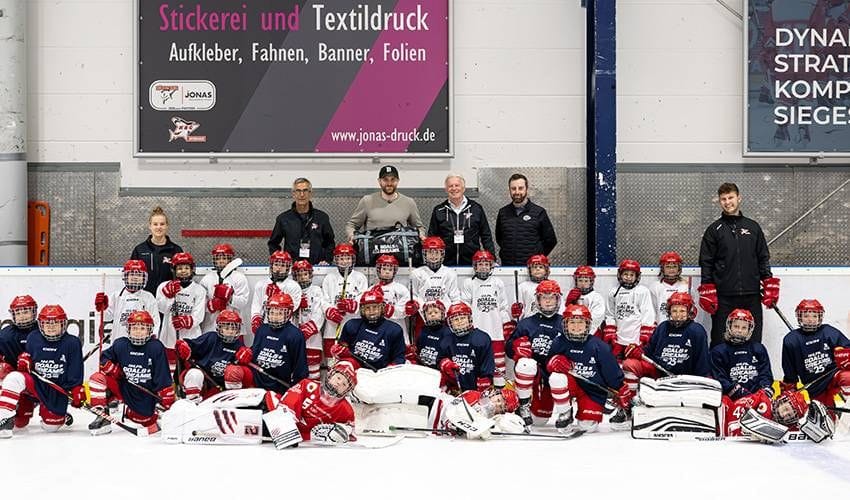
Leon Draisaitl presents his hometown Cologne Sharks with an equipment donation through NHLPA Goals & Dreams.
In LaRonge, where drugs, alcohol and poverty are an everyday reality for a segment of the community, the rink is a focal point. G&D has literally helped open the door to the rink that might have forever remained closed to a large group of kids and their families.
“It was nothing but total appreciation. And, I mean, instead of, you know, effing cops, it was, hey, thank you very much for giving my child a chance to participate in this,” Nicol said. “And the smiles, like the one dad, his little girl had never skated before, and she didn't even need a chair. It was like she had been skating for 10 years. It was just amazing to watch, and then he just had this huge smile on his face as he was standing on the players’ box. And he said, ‘Well, I guess we're going to be spending a lot of time at the rink now.’”
Andrew Wolfe took over as Director, NHLPA Goals & Dreams this past season. He is fresh from a trip to Cologne, Germany, where he joined former Ted Lindsay Award recipient and Hart Trophy winner Leon Draisaitl in committing a total of 58 sets of new equipment for this season and next, benefitting the kids of the Kolner Haie (Cologne Sharks) youth hockey groups. The youth arm of the team, the Junghaie, is the only youth hockey group in Cologne. Draisaitl, who wears No. 29, hence the 29 sets of equipment per year for the next two seasons, developed his love of the game while playing in the Junghaie program.
Every player’s involvement with NHLPA Goals & Dreams is meaningful. That is a given. Although, when a superstar like Draisaitl not only supports G&D but embraces the process and takes time out of a short summer to be part of an event like the one that took place in July, it sends an important message to other NHL players and to organizers and volunteers in hockey communities around the world.
“Think about what someone like that means to hockey there,” Wolfe said. “Him going back there was awesome. I think everyone had a great experience. He was so relaxed and totally in his element interacting with the kids. It really couldn’t have gone any better.”
The Draisaitl event illustrates again the personal moments that make NHLPA Goals & Dreams projects so meaningful on so many levels.
“He truly wants to give back to where he grew up,” Wolfe said. “They all got their start somewhere, right?”
The Police Athletic League has been a fixture in Detroit since 1969, two years after riots devastated the border city, offering kids an opportunity to play in a dozen different sports and activities including hockey. In recent years, though, the PAL hockey program disappeared in large part due to the rising costs associated with the sport.
David Greenwood spent 28 years with the Detroit Fire Department. He was a PAL kid growing up, although he wasn’t a hockey kid. He did, however, grow to love the game while attending Lake Superior State University. When Greenwood left the fire department a few years back to take on a role with PAL he was determined to bring hockey back to some of Detroit’s disadvantaged kids.
“I thought it would be cool to get inner-city kids exposed to the great game of hockey,” Greenwood said.
A friend, who was a referee, connected Greenwood with the NHLPA Goals & Dreams program as G&D was looking to give a boost to grassroots programs in major metropolitan centres like Detroit and Chicago. Soon after Greenwood reached out to colleagues with the police department and he had a team ready to take advantage of G&D’s long-term plans to support the program.
The first year in 2021-22 the Detroit PAL group ended up receiving 50 sets of equipment and there was a waiting list of kids who wanted to take part. Since that time, 140 new sets of equipment have helped establish a bedrock of hockey in the city.
“We thought it was a huge success,” Greenwood said. “We just started from a grassroots, ground level. Most of them had never been exposed to hockey before that day in their life. They didn't know how to skate. And then, year two, they got better, year three, even better now. I think we're in year four or five now. And now they're getting to the point where it's time for them to compete.
Greenwood and his PAL team found other advocates like Michigan-based Biggby Coffee who helped secure ice time, and the program continues to thrive.
Each year, 40 or 50 kids get to experience the almost indescribable moment of getting their own skates and gloves and helmets. Many have to be educated on how to put on the equipment, in which order the foreign-looking pads and straps are applied. Some have never held a hockey stick so there is education on that front, too.
“It wasn't just showing up at the hockey rink and saying, ‘hey kids, here's the skates, go out there and go to it,’” Greenwood said. “We had to do a lot of prep work prior to the first day on the ice. So, they actually did a lot of, you know, land hockey or, you know, street hockey, if you will. And, you know, teaching kids how to hold the stick. You know, teaching kids how to, you know, control a puck, or move the puck.”
Now, some of the kids have gone on to play in more established youth programs in the Detroit area.
“Now we're kind of almost a feeder system, if you will, for some of the hockey programs in Metro Detroit. The kids that are excelling will wind up going off to some of the more competitive groups, which is fine with us. But we do eventually want to have our own in-house hockey team that can travel and compete against, you know, the Little Caesars and all of the others,” Greenwood said.
All the volunteers who help with the PAL’s 12 different sporting programs that service 93 different communities in the Detroit area must do training to help them learn about the kinds of kids the volunteers will be dealing with. That means understanding that 73% of the participants are kids who rely on school meal programs because there’s not enough money at home to provide on their own.
“So, that means you're talking about a kid coming from a family or household that doesn't necessarily have the financial resources to not just play hockey, but they can't participate in a lot of the pay to play sports. So, parents are trying to figure out, ‘what do I do with my kid?’” Greenwood explained.
Not all the kids come from such backgrounds, “But there are a lot that come from a struggling environment. And this provides yet another way for them to get motivated, stay motivated, do well in school, and hopefully, you know, transition all of those things to doing well in life,” Greenwood added.
A project like this is always about more than learning a cross-over or how to take a backhand.
Many of the PAL kids are Black or come from varying ethnic backgrounds. Some are new to North America. Hockey, of course, is a predominantly white sport, but the PAL kids who have learned to skate and pick up the game have by extension been given opportunities to play against other kids whose background is different. What they have discovered is that they are connected by the game despite those economic or cultural differences. The kids from those other communities also feel that sense of connection, too.
“That is so important to me,” said Greenwood who said he was one of a small group of Black students when he was going to college. “You find out you have so many things in common. It’s a learning experience on both sides of the aisle.”
“I always say, ‘you can’t be it if you can’t see it,’” Greenwood added. “NHLPA Goals & Dreams helps kids see it.”