

There is something about this gathering at venerable Clark Park in Detroit almost in the shadow of the Ambassador Bridge and the Gordie Howe International Bridge that speaks to order in the hockey universe.
Almost as if the hockey gods – if you believe in such deities – had nodded in approval and agreed that Bob Goodenow was worthy of such a moment.
And if there are hockey gods, well, you can be sure Goodenow’s first order of business upon arriving in what we might call hockey heaven was to make sure the hockey gods were unified in their financial goals and pulling for each other.
And so it was that Goodenow’s friends and family paid tribute to a long and historic hockey journey, the closing of a great hockey circle if you will.
Goodenow’s father skated at Clark Park in the 1930s as a part of the Southwest High School team.
So, too, did Goodenow and his son, Joe. And three years ago, Goodenow’s grandson, R.L., then six years old, skated with his youth team here and scored a goal.
There’s a picture that was shown often on this remarkable day of R.L. on the ice, Goodenow and Joe at the boards watching the action intently. It’s a keeper. And it speaks to the ties that bind so many to the game and the game to so many.
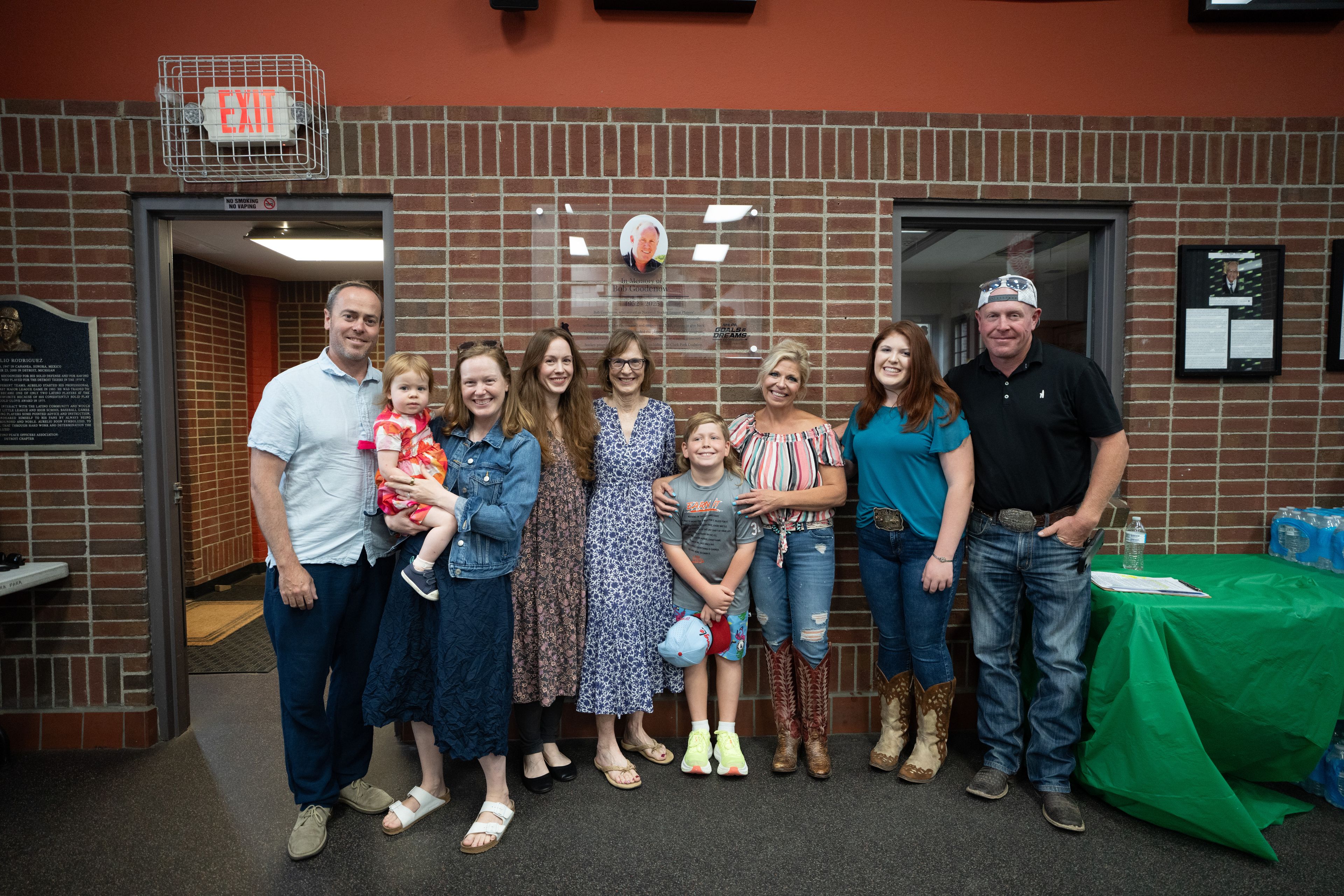
In the brick clubhouse that serves as the nerve center for Clark Park activities, a few feet from a bank of cubbies holding all manner of hockey equipment, Goodenow’s family and friends, including a handful of former NHL players from the Detroit area, gathered as a plaque from the NHLPA affixed to one wall was unveiled memorializing Goodenow for his commitment to the game of hockey.
The unveiling came a year and two days after Goodenow passed away on Sept. 13, 2025, at the family home in Plymouth, Michigan.
The plaque will serve to remind the kids, parents, and volunteers who make Clark Park such a special place in this community of Goodenow’s lofty place in the hockey world at every level literally around the world.
But the real hockey story, the real story of Goodenow’s legacy as a hockey visionary and builder, isn’t the plaque but the activity that took place outside the doors to the clubhouse in the minutes after the plaque was uncovered.
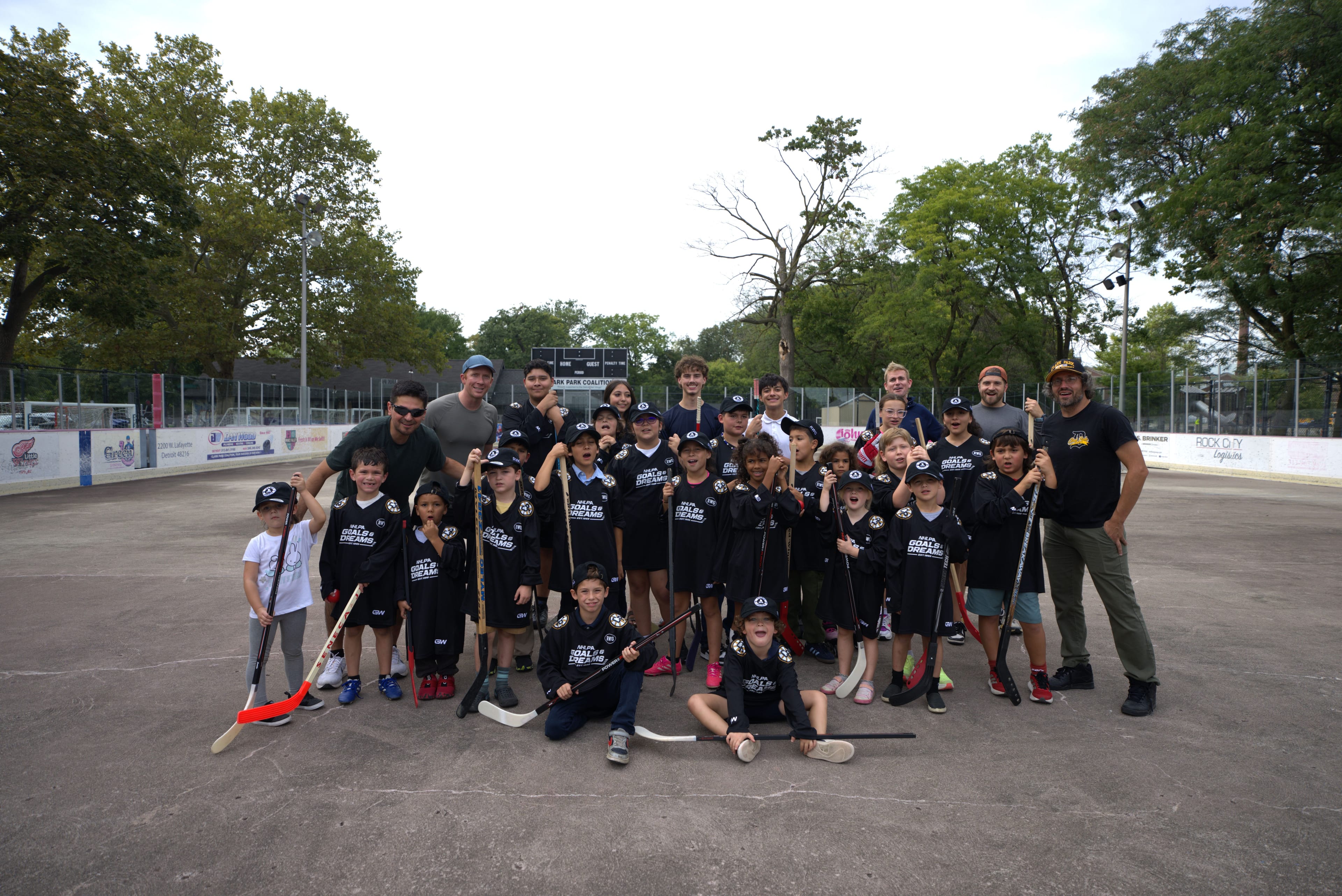
On the cement pad of the outdoor rink – a rink once closed by the City of Detroit because there were no funds to operate it until the community rallied and took control to make sure there would be outdoor hockey in Hockeytown and now the only outdoor rink in the border city – dozens of youngsters from the Clark Park area pulled on hockey gloves and clutched street hockey sticks while some donned goalie equipment and quickly formed small games of ball hockey across the width of the rink.
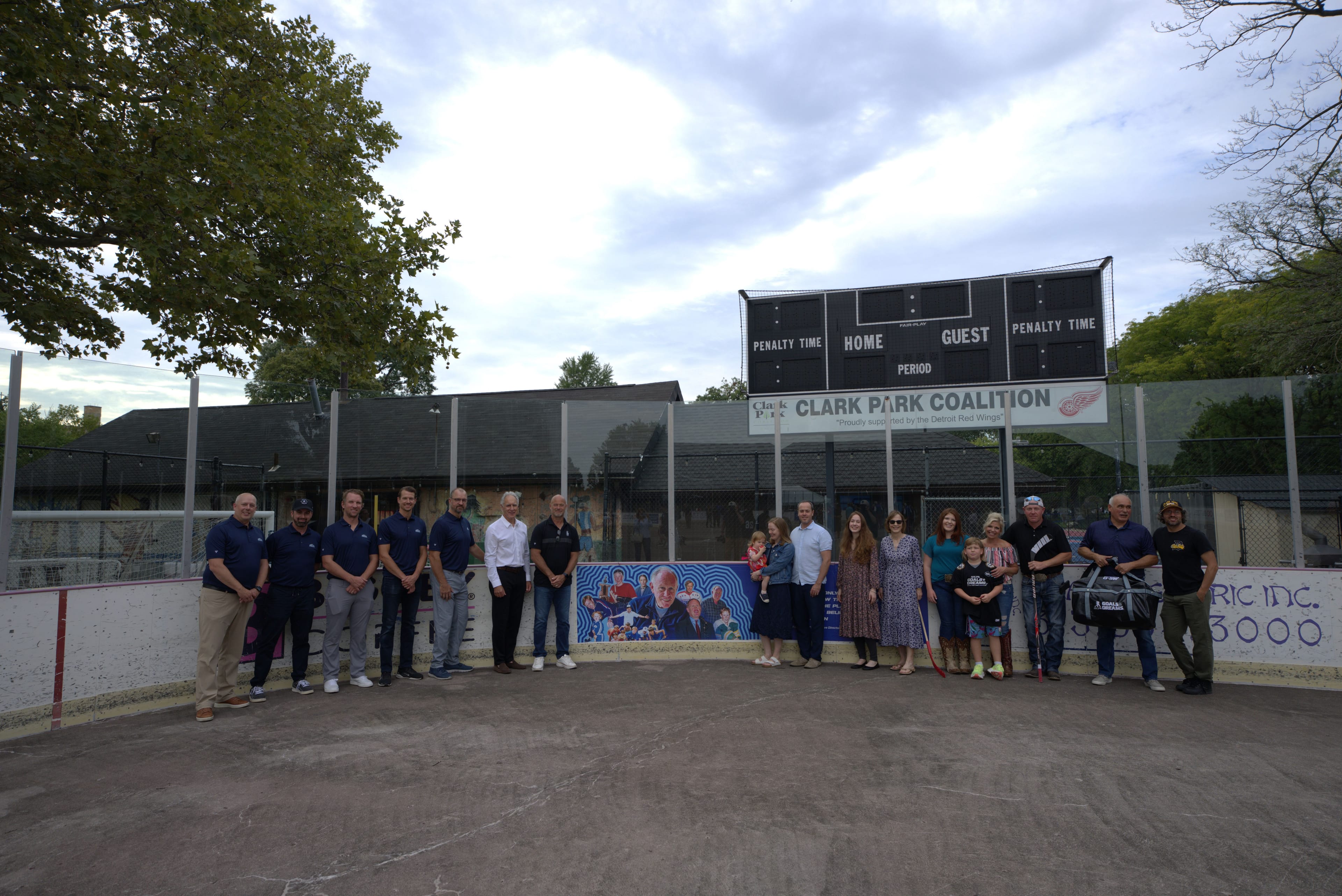
At one end of the rink Goodenow’s wife, Wendy, deftly stepped over and around ball hockey balls as they bounded into a corner. She was standing a few feet from a section of the boards bearing Goodenow’s likeness from various points in his life, from a youngster in Dearborn, Michigan, through his time as one of the most powerful and influential men in the game during his tenure as Executive Director of the National Hockey League Players’ Association.
She and Goodenow attended the same grade school but didn’t really meet until high school. Their first date involved a showing in the Goodenows’ basement of a home movie from a championship hockey game that Goodenow played in.
Wendy joked that it’s a good thing she thought Goodenow was cute so that there was a second date, but in truth hockey has bound them together and their three children and three grandchildren in ways no one could have imagined at the time. It still does.
When it gets cold enough outside to make ice many of these kids will be back strapping on skates and gear, some for the first time, gear that was donated by the NHLPA Goals & Dreams program – a program Goodenow envisioned in the first months he was on the job as the head of the NHLPA.
Even after he stepped away from the NHLPA in 2005 Goodenow remained committed to the Clark Park hockey program and was working to make sure NHLPA Goals & Dreams would help keep hockey thriving in this mostly working-class neighborhood.
“He would be very proud to see that it's come to fruition,” Wendy said.
“And I think they were working on even more [at Clark Park]. So, maybe some of that will happen. But as you know, Bob is like a dog with a bone. When he wanted something to happen, he would make it happen. So, I'm just proud that he could help these kids,” Wendy added.
The Clark Park kids, who range in age from three to 18, reflect the true spirit of NHLPA Goals & Dreams. More than $27 million has been donated to programs like this in 45 countries around the world since 1999.
On this day, the NHLPA formally announced a two-season donation of 35 sets of equipment from NHLPA Goals & Dreams to Clark Park – covering the 2025-26 and 2026-27 hockey seasons – plus a five-year commitment of giving that will help keep the Clark Park hockey program thriving.
NHLPA Goals & Dreams was Bob Goodenow’s dream for how NHL players could make a mark in their communities and grow the game in literally every corner of the globe.
It’s a dream that in some ways seems at odds with Goodenow’s public persona as a hard-as-nails, take-no-prisoners negotiator whose tenure as the Executive Director of the NHLPA from 1992 to 2005 was marked by difficult negotiations with the NHL.
Mike Gartner, inducted into the Hockey Hall of Fame in 2001, was a team representative with the NHLPA while an active player. He then then became Director of Business Relations for the NHLPA after he retired.
“Bob was always a hockey guy,” Gartner said. “He played at Harvard and he loved the sport. He loved the players. He had so much respect for the players and worked so hard for them. We had been through kind of the wars together. And I think that that's where we formed our friendship.”
One of the first conversations the two men had when Gartner joined the NHLPA was about Goodenow’s desire to create a program that would bind the players to the future growth of the game.
“Bob said, ‘Mike, I really want to do something to give back to the game from the players,’” Gartner said.
Goodenow was adamant this was a program that wouldn’t be done in half measures and that it would be something long-lasting in its impact on the players and the game.
Gartner enlisted fellow staffer Devin Smith and they proceeded to crisscross the globe with bundles of sticks and bags of new equipment in tow.
While Smith and Gartner and other NHLPA staff who helped out were feted from Siberia to rural Saskatchewan, Goodenow stayed largely out of any limelight created by NHLPA Goals & Dreams.
To see Goodenow honoured in his hometown for work that went largely unrecognized is a fitting nod to his legacy and to the ongoing importance of NHLPA Goals & Dreams.
“It’s incredibly meaningful. He should be known for starting the program that has impacted thousands and thousands of people everywhere in the world,” Smith said.
“He did a lot of great things for the players. Bob was tough. But Bob also had a good heart,” Gartner added. “And this is really just something that we got to see, the good side of Bob more than most people did. I know I certainly did. I mean, it's a great legacy in the game for the players and all he did for the players, but this was a great legacy of what he left the game.”
In the clubhouse at Clark Park there’s a sheet of paper on the wall that reminds youth hockey players and their families of the correct order of putting on hockey gear. That’s because about 90% of the kids who come to the program are first generation hockey players coming from homes where no close family member played the game.
Joseph Yelick is the Clark Park Hockey Manager who usually answers to Coach Joe to the hundreds of kids and their families who have passed through the program since he started helping out in late 2018.
Yelick has played hockey his whole life and coached and volunteered for two decades including coaching the in Detroit’s more affluent suburbs. There is something unique about what happens at Clark Park.
“It’s really rewarding to grow the game of hockey through the community of people that are not just Caucasian or white or European ancestry,” Yelick explained.
He oversees learn to skate and learn to play programs with community partners like the Detroit Police Athletic League and of course the NHLPA and Goals & Dreams.
Sometimes the kids, about 40% of whom are girls, go on to play in traditional youth hockey organizations and some Clark Park graduates have gone on to play AAA hockey and even college level hockey. But that’s not the goal.
In fact, here’s what happens when a program like Clark Park’s works.
Yelick recalled a boy showing up to play when he was 15 or so. He’s now an adult, 23, and he comes back and volunteers his time helping maintain the ice.
One woman who went through the program is at Wayne State University and still playing hockey. Her younger brothers are in the Clark Park program now.
“It’s just about having these caring adults in her life, and she had these caring adults here at Clark Park under coaches and other staff. Now she's at Wayne State getting her degree. And that's what it's about, and that's growing the game to me, and that's what Goals & Dreams is doing to grow this game,” Yelick said.
“We're not asking our players to be NHL players. The goal is to go out and play and keep that socialization skill, come back here and play as an adult too, and give back. And then hopefully they won't be the first gen, so hopefully they'll have a second gen that'll play here. And then a third gen, and we'll keep growing the game. And it'll make hockey better, being more diverse,” Yelick explained.
Coach Joe didn’t meet Goodenow in person, but he was part of email chains as the organization worked on applications to NHLPA Goals & Dreams to request new equipment to inject into the hockey lifeblood of the program.
“There's no way to properly talk about how important it is in the here and now, because it's something that's going to have ripple effects down the line,” Yelick explained. “And so, my words don't do justice to what Bob's doing and what he's done. He’s given hockey to a community that otherwise wouldn't have it.”
Sitting outside the clubhouse on a table was the Ted Lindsay Award, the players’ most outstanding player award as voted on by the NHLPA membership. In many ways the trophy reflects the NHLPA’s sense of unity and purpose. Among the names on the trophy is former netminder and longtime player agent Mike Liut.
Liut recalled that Goodenow’s vision for the players when he took over as Executive Director was that players could earn enough money to support their lives after hockey.
“So, when you extrapolate from that, he got the players to understand how important they were to each other,” Liut added. “And in that sense where we're all cheering for each other.”
“So, for me, Bob is clearly one of the five most influential people in the history of the game,” Liut added.
Long after the official parts of this event and the ball hockey games ended, people lingered in the waning sunlight, munching pizza and chatting, seemingly reluctant to see the moment end.
For many who knew Goodenow personally the day is bittersweet, the event a reminder of what has been lost but also a reminder that his presence will continue to be felt in this community and hundreds of others long into the future.
“He understood the responsibility that players have,” Liut said.
“You're fortunate that you are in a position where you got to play this game. You had parents that brought you to the rink and exposed you and gave you the opportunity. And then you took it and you developed it into something. But you still owe something back. Pay it forward, however you want to phrase it. But it was very much about Bob giving back. He was a very generous person that way.”